Building a Tech Portfolio That Non-Tech Clients Understand
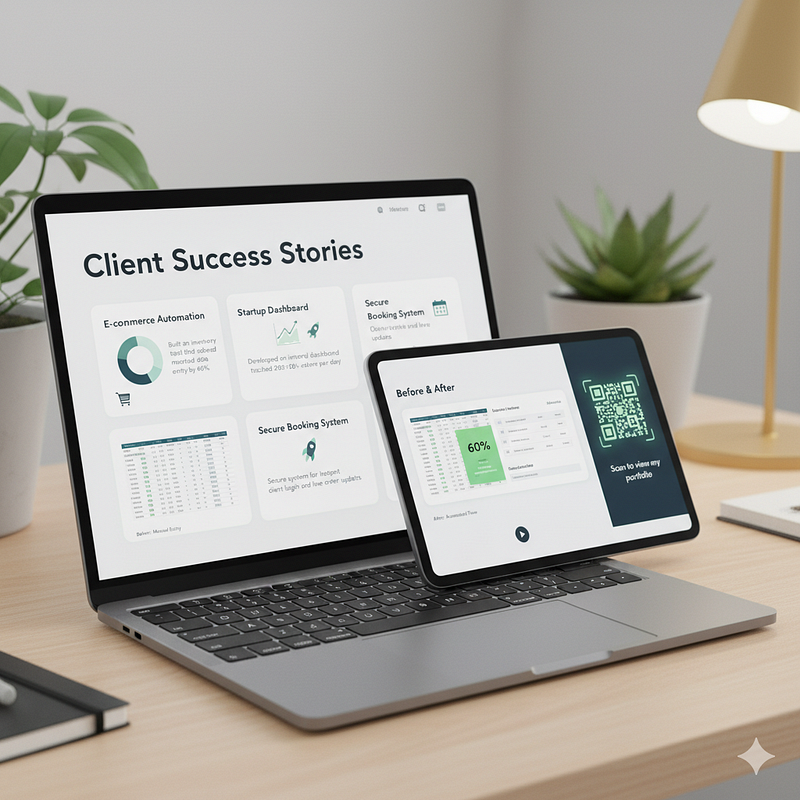
Most developer portfolios?
They’re built for other developers, not for the people who actually pay.
You know the kind — dark mode, matrix fonts, animated terminal greetings, and a “Projects” section that lists five GitHub links and a wall of screenshots.
Looks cool.
Impresses other coders.
But if your audience is a small business owner, startup founder, or designer … you’ve probably lost them in the first 10 seconds.
I learned this the hard way.
The Day My Portfolio Failed
A few years ago, I had a potential client — a bakery owner named Leena.
She wanted an ordering app for her customers. I sent her my portfolio (I thought it was slick).
Next day, she called.
Her exact words:
“It looks… technical. But I don’t really get what you do.”
Ouch.
That’s when it hit me — I wasn’t selling code, I was selling clarity.
Speak the Client’s Language
If your portfolio sounds like a developer resume, you’re missing the point.
Clients don’t care about “React state management” or “Laravel back-end APIs.”
They care about results: “This tool saves you 2 hours a day,” or “This website brought in 30% more leads.”
So instead of saying:
“Built an e-commerce app with Stripe API and React Context.”
Try this:
“Built a small business store that automated 90% of payment handling — no tech skills needed.”
One speaks to you.
The other speaks to them.
That’s why I switched to a more human-first approach using a no-code portfolio builder for tech freelancers. It lets me frame each project as a story, not just a feature list.
Tell Stories, Not Specs
Every project should read like a mini case study.
What was the problem?
Who was it for?
What did you build?
And most importantly — how did it help?
For example, one of my projects was for a gym owner who kept losing leads through WhatsApp chaos.
So I built a lead tracker dashboard — simple stuff, nothing fancy.
But when I wrote about it, I told the story:
“John used to miss 10 client messages a week. Now he doesn’t miss a single one.”
Boom.
That’s impact.
I crafted that post through a portfolio storytelling tool for developers that focuses on outcomes instead of buzzwords.
Simplify the Design (Seriously)
You don’t need a 3D animated interface.
You need breathing space, big text, and words that feel human.
I used to spend weeks tweaking colors and transitions — until a mentor told me:
“Your code is impressive, but your copy sells the deal.”
Now, I keep my portfolio design clean using a minimalist portfolio maker for freelancers.
It handles the layout, and I focus on writing what matters.
Add Emotion — Even in Tech
It’s easy to forget that clients buy from people, not robots.
A small section about why you build what you build can shift everything.
For instance, I added a short story about how my uncle’s failed business inspired me to make websites that actually convert.
Clients love that kind of stuff.
It’s human.
It’s relatable.
Even better, you can include such backstory sections with a customizable portfolio tool for creators and developers. It feels more like a conversation than a catalog.
A Quick Portfolio Checklist
If your goal is to attract non-tech clients, here’s what I’ve learned works best:
✅ Use simple language — pretend you’re explaining to your aunt.
✅ Write small stories, not feature lists.
✅ Add “Before vs After” results.
✅ Keep the design minimal.
✅ Show photos of real clients or messages (with permission).
✅ Use a no-code builder like this one for tech portfolios to save time.
And if you ever feel your portfolio isn’t “perfect” — relax.
It shouldn’t be.
It should be real.
“Hey, I finally understand what you do.”
That’s the best compliment a tech person can get.
So, my advice?
Stop trying to look smart.
Start trying to sound human.
Your next client probably doesn’t care about your stack — they care if you can help their business grow.
And if you can communicate that, you’ve already won.
Originally published at https://visitfolio.com.